
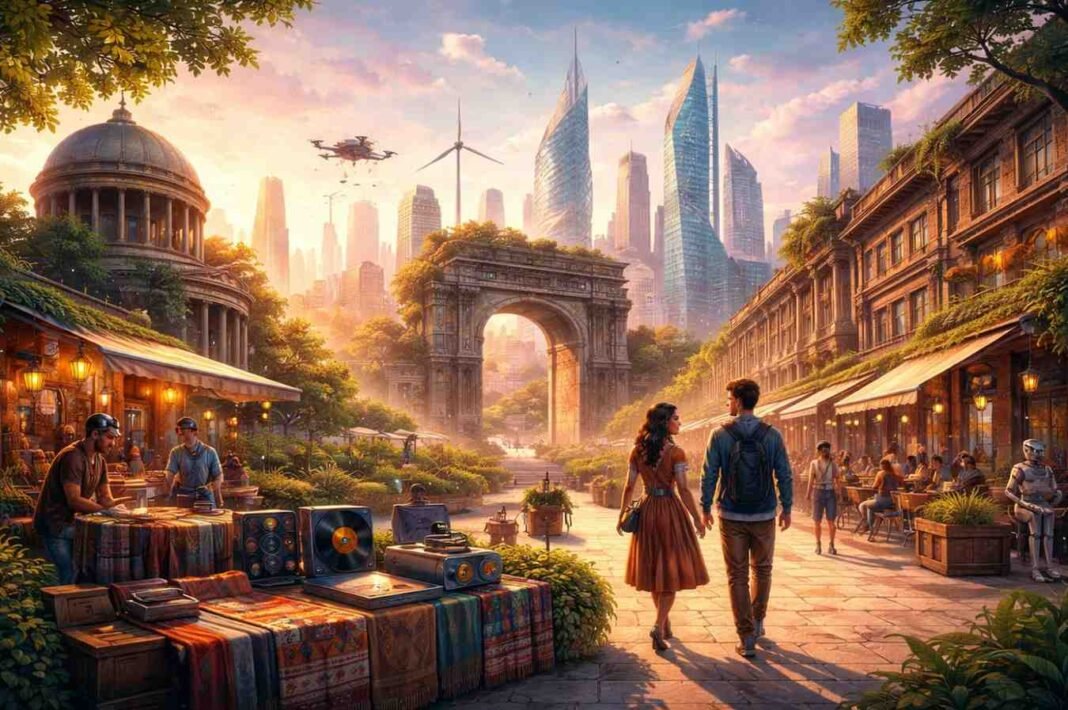

Modern culture is often portrayed as fast, digital, and forward-facing. But look a little closer, and you’ll notice something more interesting happening beneath the surface. Today’s culture isn’t rejecting the past—it’s actively remixing it. From fashion and architecture to technology and social values, modern culture is the living intersection where history meets innovation.
This dynamic blend is what makes our era unique. We are not simply moving forward; we are carrying centuries of ideas, traditions, and lessons with us—reimagined for a rapidly changing world.
Understanding Modern Culture in a Historical Context
Culture has never evolved in isolation. Every generation inherits the beliefs, art forms, systems, and struggles of those before it. What distinguishes modern culture is how consciously it engages with history.
Instead of preserving tradition unchanged, modern society adapts it. Ancient philosophies influence contemporary wellness practices. Classical art principles shape digital design. Even long-standing social structures are being revisited, questioned, and rebuilt with modern values in mind.
In this sense, modern culture is not a clean break from the past—it’s a conversation with it.
How Innovation Revives Historical Traditions
Innovation doesn’t erase history; it gives it new life.
Fashion: Old Styles, New Statements
Vintage fashion is no longer niche. Elements from the 70s, 80s, and 90s dominate modern runways and streetwear, enhanced with sustainable materials and inclusive design. Traditional textiles from Asia, Africa, and Latin America are being incorporated into global fashion—often with modern silhouettes and ethical production methods.
The result is clothing that tells a story, blending heritage with modern identity.
Architecture: Timeless Design Meets Smart Technology
Modern architecture frequently borrows from classical principles—symmetry, proportion, natural light—while integrating smart technology and eco-conscious materials. Historic buildings are being repurposed rather than demolished, preserving cultural memory while serving contemporary needs.
This approach reflects a broader cultural mindset: progress doesn’t require destruction.
Technology as a Cultural Bridge Between Past and Future
Technology is often viewed as the ultimate symbol of modernity, yet many innovations are rooted in historical ideas.
- Artificial intelligence draws inspiration from early philosophical questions about human thought.
- Social media echoes ancient forms of storytelling and community gathering.
- Digital archives are preserving languages, manuscripts, and traditions that once risked disappearing.
In modern culture, technology acts as a translator, carrying historical knowledge into the future while making it accessible to more people than ever before.
Art and Entertainment: Reinvention, Not Replacement
Modern films, music, and literature constantly reference the past. Mythology inspires superhero franchises. Classic novels are retold through diverse, contemporary lenses. Music genres like hip-hop and electronic frequently sample older sounds, transforming them into something entirely new.
This creative recycling isn’t a lack of originality—it’s proof that history still resonates. Innovation thrives when it has roots.
Social Values: Tradition Reexamined Through a Modern Lens
One of the most powerful examples of modern culture meeting history is in the evolution of social values.
Concepts like democracy, justice, and human rights have ancient origins, yet modern culture continuously reshapes them. Long-standing traditions are being questioned to create more inclusive, equitable societies. At the same time, communities are reclaiming historical identities that were once suppressed.
Modern culture doesn’t blindly accept or reject the past—it interrogates it, keeping what works and improving what doesn’t.
Globalization and Cultural Fusion
Never before have cultures interacted on such a scale and speed. Globalization has turned modern culture into a mosaic of influences.
Food, language, music, and fashion cross borders instantly, creating hybrid cultures that honor multiple histories at once. While this raises valid concerns about cultural dilution, it also opens doors to collaboration, understanding, and creative growth.
When handled with respect, cultural fusion becomes a powerful example of history and innovation coexisting.
Why This Intersection Matters More Than Ever
In a world facing rapid technological change and social uncertainty, the balance between history and innovation provides stability and direction.
- History offers perspective and wisdom.
- Innovation provides tools and solutions.
- Culture connects the two, shaping how societies move forward.
Modern culture thrives when it acknowledges its roots while remaining open to change.
The Future of Modern Culture
As innovation accelerates, the role of history will become even more important. The most impactful cultural movements of the future won’t come from abandoning the past, but from understanding it deeply—and then building something better.
Modern culture is not a destination. It’s an ongoing process, shaped by memory, creativity, and imagination.
Final Thoughts
Modern Culture: Where History Meets Innovation is more than a phrase—it’s a reality we live every day. From the clothes we wear to the technology we use and the values we uphold, our present is a carefully woven fabric of old and new.
And that is what makes modern culture not just relevant—but meaningful.