
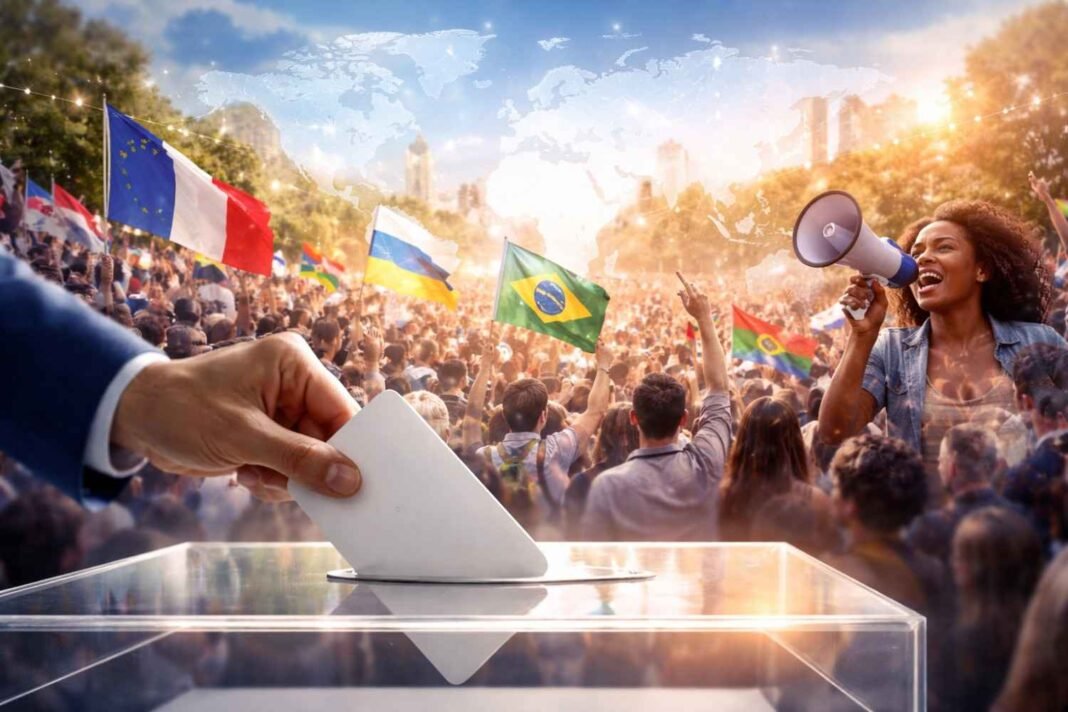

Democracy is often described as a system of government, but in practice, it is something far more dynamic. It is lived, contested, defended, and reimagined every day by citizens across the world. From ballot boxes in fragile states to mass protests in established democracies, democracy in action: global political stories reveal not only how power is exercised, but how societies negotiate freedom, accountability, and representation.
In a rapidly changing political landscape, these stories matter. They show us where democracy is thriving, where it is under strain, and how ordinary people continue to shape political outcomes—sometimes quietly, sometimes dramatically.
Democracy Beyond Definitions: A Living Political Process
Political textbooks often define democracy in neat terms: free elections, separation of powers, rule of law. Yet real-world democracy is rarely tidy.
Across continents, democratic systems are constantly adapting to new pressures—digital misinformation, economic inequality, climate crises, and shifting geopolitical alliances. What emerges is not a single model of democracy, but many versions shaped by culture, history, and civic engagement.
This is why democracy in action: global political stories offer such powerful insight. They capture democracy not as an abstract ideal, but as a process unfolding in real time.
Grassroots Movements and the Power of the Public
One of the most striking features of modern democracy is the role of grassroots activism. In recent years, citizens have increasingly taken political participation into their own hands, organizing outside traditional party structures.
- In parts of Latin America, mass demonstrations have pushed governments to address corruption and social inequality.
- Across Africa, youth-led movements are demanding transparency, fair elections, and economic opportunity.
- In Asia, civil society groups continue to challenge restrictions on speech and assembly, often at great personal risk.
These movements remind us that democracy does not begin and end on election day. It lives in town halls, courtrooms, streets, and online spaces where citizens hold leaders accountable.
Elections Under the Global Spotlight
Elections remain the most visible expression of democracy in action. Yet they are also increasingly complex and contested.
Around the world, recent elections have highlighted both democratic resilience and vulnerability:
- High voter turnout in polarized societies shows continued faith in democratic participation.
- Allegations of interference, misinformation campaigns, and voter suppression expose weaknesses that demand reform.
- Independent election monitors and journalists play a critical role in maintaining public trust.
These global political stories underscore a key truth: elections alone do not guarantee democracy, but credible elections are essential to its survival.
Democracy Under Pressure: Authoritarian Drift and Resistance
Not all stories are optimistic. In several regions, democratic backsliding has become a defining political trend. Concentration of executive power, attacks on independent media, and weakened judicial systems pose serious challenges.
However, even in these environments, democracy rarely disappears quietly.
Judges who uphold constitutional limits, journalists who continue reporting despite threats, and citizens who refuse to disengage all form part of democracy’s defense mechanism. Their actions may not always succeed in the short term, but they shape long-term political culture.
These struggles are central to democracy in action: global political stories, revealing how democratic values persist even when institutions falter.
Digital Democracy: Opportunity and Risk
Technology has transformed how democracy functions. Social media platforms amplify political voices, mobilize voters, and expose wrongdoing faster than ever before. At the same time, they enable misinformation, polarization, and foreign influence.
Around the globe, governments and civil society are grappling with critical questions:
- How do we protect free speech while limiting harmful disinformation?
- Who regulates digital political advertising?
- Can technology strengthen democratic participation without undermining trust?
The answers are still evolving, making digital governance one of the most consequential democratic debates of our time.
The Role of International Institutions and Global Solidarity
Democracy does not exist in isolation. International organizations, election observers, human rights courts, and global media networks all influence how democratic norms are upheld.
While critics argue that external pressure can infringe on sovereignty, supporters note that global accountability often provides protection for vulnerable democracies. Sanctions, diplomatic engagement, and international legal mechanisms have all shaped political outcomes in meaningful ways.
In an interconnected world, democracy in action: global political stories increasingly cross borders, reminding us that democratic decline or progress in one country can have ripple effects far beyond its borders.
Why These Stories Matter More Than Ever
At a time when public trust in institutions is wavering, global political stories offer context, perspective, and accountability. They help citizens distinguish between temporary political turbulence and deeper democratic erosion.
More importantly, they reinforce a crucial lesson: democracy is not self-sustaining. It requires participation, vigilance, and informed engagement.
Whether through voting, peaceful protest, investigative journalism, or community organizing, people remain the driving force behind democratic systems.
Conclusion: Democracy as a Shared Responsibility
Democracy’s future will not be decided by ideology alone, but by action. The stories unfolding across the globe show that while democracy is imperfect and often fragile, it remains remarkably resilient when citizens refuse to disengage.
By paying attention to democracy in action: global political stories, we gain more than political knowledge—we gain insight into our collective responsibility. Democracy survives not because it is guaranteed, but because people continue to fight for it, adapt it, and believe in its promise.
In the end, democracy is not just something governments practice. It is something people do.