
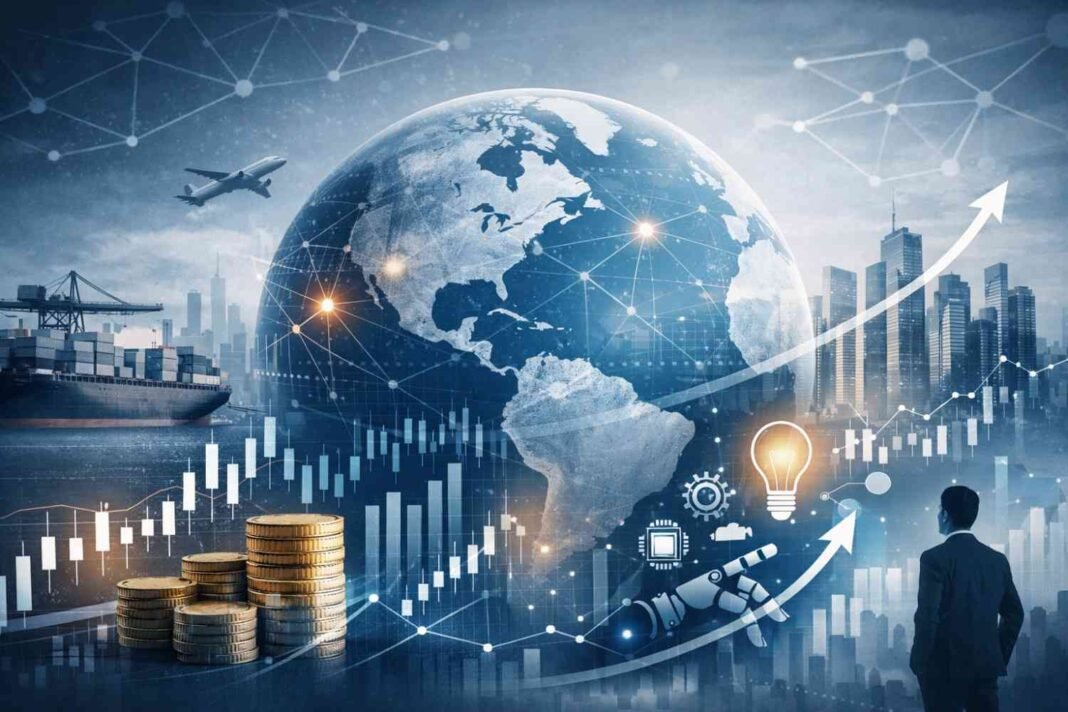

The global economy is in the middle of a structural shift unlike anything seen in recent decades. While past cycles were shaped largely by monetary policy and commodity prices, today’s economic momentum is increasingly driven by technology, geopolitics, sustainability, and demographic change. For business leaders, investors, and policymakers, understanding these forces is no longer optional—it is essential for long-term success.
This article explores business insights: trends driving the global economy, breaking down the most influential forces reshaping markets, supply chains, and competitive advantage worldwide.
1. Digital Transformation Is No Longer a Strategy—It’s the Economy Itself
Digitalization has moved beyond operational efficiency and into the core of economic growth. Artificial intelligence, cloud computing, automation, and data analytics are now foundational infrastructure for global commerce.
Key impacts:
- Productivity acceleration in advanced and emerging economies
- Lower barriers to entry for startups through scalable technology
- Data-driven decision-making is replacing intuition-based leadership.
AI-powered tools are transforming everything from logistics forecasting to customer experience. Companies that fail to modernize digitally are not just falling behind—they are becoming economically irrelevant.
Business insight: Competitive advantage increasingly comes from how well organizations integrate technology with human judgment, not from technology alone.
2. Global Supply Chains Are Being Rewritten
The era of purely cost-optimized global supply chains is over. Recent disruptions—from pandemics to geopolitical conflicts—have exposed the fragility of hyper-globalized production models.
Emerging supply chain trends:
- Nearshoring and reshoring to reduce geopolitical risk
- Supplier diversification, replacing single-country dependence.
- Inventory resilience prioritized over just-in-time efficiency.
This shift is creating new manufacturing hubs in Southeast Asia, Eastern Europe, and Latin America while redefining trade relationships between major economies.
Business insight: Resilience is now a growth strategy, not a defensive one.
3. Sustainability Is Reshaping Capital Flows
Environmental, Social, and Governance (ESG) considerations are no longer niche concerns. They are actively influencing where capital moves and which companies thrive.
Why sustainability now drives the global economy:
- Investors are pricing climate risk into valuations.
- Governments are enforcing carbon regulations and disclosure rules.
- Consumers increasingly favor responsible brands.
Renewable energy, circular economies, and green infrastructure are attracting trillions in investment, creating entirely new markets while disrupting traditional industries.
Business insight: Sustainability is not a cost center—it is a long-term value multiplier.
4. Inflation, Interest Rates, and the New Monetary Reality
After years of ultra-low interest rates, businesses are adjusting to a higher-cost capital environment. Central banks are walking a tightrope between controlling inflation and sustaining growth.
Implications for businesses:
- Capital efficiency matters more than aggressive expansion.
- Debt management has become a strategic priority.
- Pricing power separates resilient firms from vulnerable ones.
Companies with strong balance sheets and flexible pricing models are better positioned to navigate economic uncertainty.
Business insight: Financial discipline is becoming a competitive advantage.
5. The Rise of Emerging Markets as Growth Engines
While developed economies face aging populations and slower growth, emerging markets are becoming central to global expansion.
Drivers of emerging market growth:
- Rapid urbanization and middle-class expansion
- Increased digital adoption is leapfrogging legacy systems.
- Infrastructure investment and regional trade agreements
Asia, Africa, and Latin America are becoming more than just manufacturing hubs; they are independent consumer markets and centers of innovation.
Business insight: Future growth increasingly comes from understanding local markets, not exporting old models.
6. Workforce Transformation and the Talent Economy
Human capital is undergoing a profound shift. Remote work, demographic changes, and evolving employee expectations are redefining how organizations operate.
Major workforce trends:
- Remote and hybrid work is becoming standard.
- Growing demand for digital and analytical skills
- Increased focus on employee well-being and purpose
Talent shortages in key sectors are influencing wage growth, automation investment, and global hiring strategies.
Business insight: The ability to attract, develop, and retain talent is now as critical as access to capital.
7. Geopolitics and Economic Fragmentation
Economic globalization is no longer driven solely by efficiency. Political considerations now play a major role in trade, investment, and technology transfer.
Key geopolitical trends:
- Strategic competition between major powers
- Technology nationalism and export controls
- Regional trade blocs are gaining influence.
Businesses must now account for political risk alongside market opportunity.
Business insight: Geopolitical awareness is a core leadership skill in the modern economy.
8. Consumer Behavior Is Changing Faster Than Ever
Digital access, economic uncertainty, and shifting values have transformed consumer expectations globally.
Notable consumer trends:
- Demand for personalization and speed
- Preference for value-driven purchasing
- Growth of subscription and experience-based models
Brand loyalty is increasingly earned through trust, transparency, and consistent value delivery.
Business insight: Understanding consumers requires continuous listening, not static market research.
9. Innovation Cycles Are Shortening
The pace of innovation is accelerating, compressing product life cycles and intensifying competition.
What this means for businesses:
- Faster experimentation and iteration
- Greater collaboration across ecosystems
- Increased importance of intellectual property
Companies that build cultures of learning and adaptability outperform those relying on past success.
Business insight: Agility beats size in today’s economy.
Conclusion: Turning Global Trends into Strategic Advantage
The forces shaping today’s global economy are interconnected, fast-moving, and complex. Digital transformation, sustainability, supply chain resilience, and geopolitical awareness are no longer separate conversations—they are part of a single strategic reality.
Businesses that succeed will be those that:
- Think long-term while acting decisively.
- Balance innovation with financial discipline.
- Align economic goals with societal impact.
By understanding business insights: trends driving the global economy, leaders can move beyond reacting to change and begin shaping it.
In a world defined by uncertainty, insight is the most valuable currency of all.